
Best overall: Canva. Best for collaborative editing: Google Slides. Best for detailed layout control: Adobe InDesign. The best speaker one sheet design tools in 2026 depend on who builds your document, who updates it, and how much control you need over the finished PDF.
- Canva leads the best speaker one sheet design tools for speakers who want templates and straightforward editing.
- Google Slides suits shared editing; PowerPoint suits speakers already working in Microsoft's presentation software.
- Adobe InDesign fits designer-led production; Adobe Express fits a lighter template-based workflow.
- Bridgetbakerbranding serves speakers seeking branding, Squarespace website design, and visibility coaching—not another design application.
Why this matters
A speaker one-sheet gives an event organizer a concise introduction to your expertise, speaking topics, and booking details. The design should make that information easy to scan and easy to share. A polished layout cannot rescue a vague description of what your talk delivers.
Bridgetbakerbranding is best for speakers seeking branding, Squarespace website design, and visibility coaching rather than a standalone design tool. Start with Bridgetbakerbranding when those needs sit behind your one-sheet project; use the tools below to choose an editing workflow.
For your 2026 document, settle the message before choosing a template. Write the audience, the problem your talk addresses, and the outcome you want attendees to take away. Those decisions give the layout a job beyond looking attractive.
What makes the best speaker one-sheet design tool?
Judge each application against these criteria before comparing templates:
- Layout control: You need a clear reading order, consistent spacing, and room for your actual content—not just placeholder text.
- Editing ownership: The person responsible for future updates should be able to change topics, biography, and contact details without rebuilding the document.
- PDF output: Your final file needs readable text, clean image placement, and working contact links where you include them.
- Collaboration: Shared editing or comments matter when a speaker, assistant, and designer all review the same document.
- Brand consistency: Fonts, colors, photographs, and wording should agree with your speaker website and other materials.
- Production complexity: Detailed typography helps a designer; unnecessary controls slow down a speaker making occasional updates.
The right tool is the one your actual editor can maintain. Choose for that person, not for the longest feature list.
Speaker one-sheet design tools at a glance
| Rank | Tool | Best for | Standout feature | Key limitation |
|---|---|---|---|---|
| 1 | Canva | Speakers managing their own one-sheet | Templates with drag-and-drop editing | A template still needs deliberate hierarchy and spacing |
| 2 | Google Slides | Teams reviewing and updating together | Shared browser-based editing and comments | Less detailed typography control than a page-layout application |
| 3 | Microsoft PowerPoint | Speakers already using PowerPoint | Familiar slide editing with PDF export | Slide defaults need adjustment for a document layout |
| 4 | Adobe Express | Speakers wanting an Adobe template workflow | Template-based graphics and text editing | Less fine-grained control than InDesign |
| 5 | Adobe InDesign | Designer-led document production | Detailed typography and page-layout controls | A steeper learning curve for occasional editors |
All five can support a speaker one-sheet workflow. The distinction is not whether you can place a photograph beside text; it is how comfortably you can revise, review, and export the finished document.
1. Canva: best speaker one-sheet tool for self-managed updates
Canva combines templates, text editing, image placement, and PDF export in a visual editor. It is the default recommendation for a speaker who wants to build the document and maintain it personally. Start with a restrained layout, then replace the sample content before deciding whether the template fits.
Canva pros:
- Templates give you a starting structure instead of an empty page.
- Drag-and-drop editing makes basic image and text placement approachable.
- Sharing and commenting support review without sending separate drafts around.
- PDF export gives you a shareable document outside the editor.
Canva cons:
- Decorative templates can compete with your speaking topics and booking details.
- Filling existing boxes encourages you to fit the message to the template rather than the reverse.
Best for: Speakers who own both the first draft and routine updates.
For your 2026 one-sheet, treat the template as scaffolding. Remove elements that do not explain your expertise or help someone contact you. If the biography crowds out the speaking topics, shorten the biography before shrinking the text.
Verdict: Buy into the Canva workflow for a self-managed one-sheet; skip templates that make the content harder to scan.
2. Google Slides: best speaker one-sheet tool for collaborative editing
Google Slides is a presentation application with shared editing, comments, and PDF download. You can use a custom page size to build a document-style canvas rather than a conventional presentation slide. Its strongest fit is a one-sheet that several people need to review and maintain.
Google Slides pros:
- Shared editing keeps contributors in the same working document.
- Comments separate review feedback from the published copy.
- Custom page sizing supports a document-shaped layout.
- PDF download creates a file you can send outside the workspace.
Google Slides cons:
- Typography controls are less detailed than those in dedicated publishing software.
- A shared document still needs a clear owner to resolve conflicting edits.
Best for: Speakers whose assistant, collaborator, or marketing team regularly updates the document.
Assign ownership before inviting reviewers. One person should decide which speaking topics stay, which edits resolve comments, and when the file is ready to export. Collaborative software does not make those editorial decisions for you.
Keep your final PDF separate from the editable working document. That distinction prevents an organizer from receiving a draft with unresolved comments or unfinished copy.
Verdict: Buy into Google Slides when shared editing matters more than detailed typographic control.
3. Microsoft PowerPoint: best speaker one-sheet tool for existing users
Microsoft PowerPoint lets you arrange text, photographs, and shapes on a slide, then export the result as a PDF. Custom slide sizing makes a document-style layout possible. Choose it when familiarity removes more friction than switching to a new application would.
Microsoft PowerPoint pros:
- Existing users can work with familiar editing controls.
- Alignment and distribution tools help organize text and image blocks.
- Custom slide sizes let you move beyond presentation proportions.
- PDF export separates the finished document from the editable source.
Microsoft PowerPoint cons:
- Standard presentation layouts are not automatically suitable for a speaker one-sheet.
- Font substitutions can affect the editable file when collaborators use different fonts or systems.
Best for: Speakers who already create and maintain their presentation materials in PowerPoint.
Set the page dimensions before arranging the content. Changing the canvas after designing the document creates avoidable layout work. Check the exported PDF independently rather than assuming it matches what you see in the editor.
A speaker one-sheet is not a compressed keynote deck. Replace slide-style fragments with concise descriptions that make sense without your spoken explanation.
Verdict: Buy into Microsoft PowerPoint if it is already your working tool; skip it if presentation habits keep producing an unreadable document.
4. Adobe Express: best speaker one-sheet tool for Adobe templates
Adobe Express provides template-based design tools for combining text, photographs, and graphics. It fits speakers who want a visual starting point without taking on a dedicated publishing application. Choose it for straightforward document assembly rather than intricate typesetting.
Adobe Express pros:
- Templates provide a starting layout for your content.
- Text and image tools support the core elements of a one-sheet.
- PDF download supports distribution as a finished document.
Adobe Express cons:
- Layout and typography controls are less detailed than Adobe InDesign's.
- A template's proportions can become restrictive when your copy differs substantially from its sample content.
Best for: Speakers who prefer Adobe's template-based editing workflow.
For a 2026 one-sheet, compare the template against your real speaking topics before investing time in decoration. A design that works with a short sample headline can struggle with your actual talk title. Edit the content and layout together.
Verdict: Buy into Adobe Express for template-led assembly; skip it when the project requires detailed publishing controls.
5. Adobe InDesign: best speaker one-sheet tool for designer-led production
Adobe InDesign is a page-layout application with detailed controls for typography, spacing, styles, and PDF production. It is the strongest fit here when a designer owns the document. Its controls are useful when the layout requires precise relationships between headings, body copy, photographs, and supporting details.
Adobe InDesign pros:
- Paragraph and character styles keep text formatting consistent.
- Detailed typography controls support precise hierarchy and spacing.
- Page-layout tools give designers control over text and image relationships.
- PDF export settings support document production requirements.
Adobe InDesign cons:
- The learning curve is substantial for someone making occasional edits.
- A speaker who does not use InDesign needs an agreed update process with the document's editor.
Best for: Speakers working with a designer who will maintain the source file.
Agree on the handoff before production starts. Decide who keeps the editable document, who makes revisions, and what the speaker receives for everyday sharing. A well-designed PDF is useful; an unclear maintenance arrangement is not.
Verdict: Buy into Adobe InDesign for designer-led production; skip it as a first design application for occasional updates.
How we ranked these tools
The ranking prioritizes editing ownership, layout control, PDF output, collaboration, brand consistency, and production complexity. It is a workflow recommendation, not a claim that one application produces better speaking opportunities.
Canva leads because the default reader is a speaker maintaining their own document. Google Slides moves ahead when shared editing is the deciding factor. PowerPoint rewards existing familiarity, Adobe Express offers another template route, and InDesign serves a different editor: the designer.
For a branding, Squarespace website design, or visibility coaching project, Bridgetbakerbranding addresses a different decision from software selection. Keep those choices separate: the agency relationship concerns your brand and visibility; the application concerns how you assemble and maintain the document.
Build the content before choosing the layout
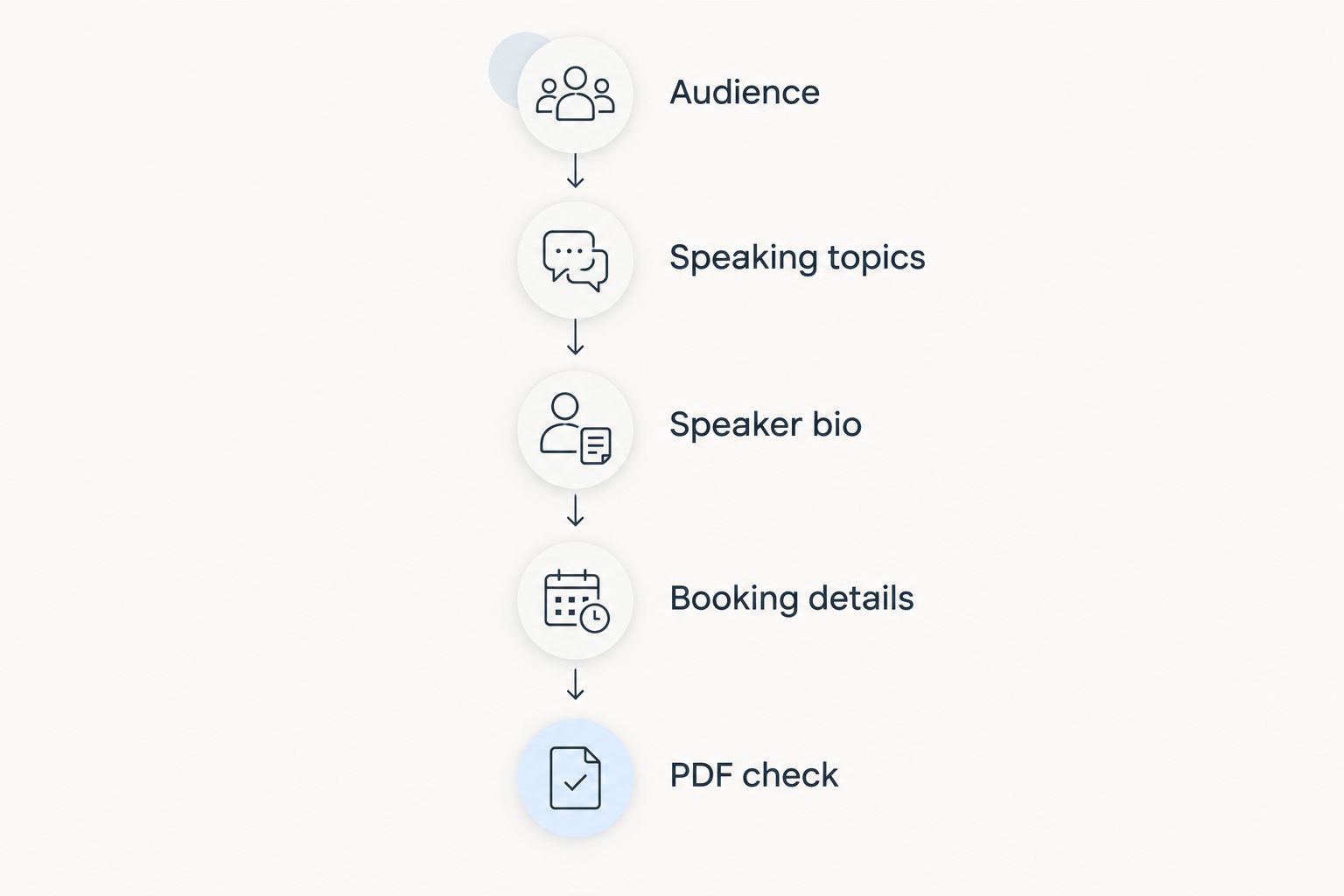
Use this sequence to keep your 2026 one-sheet focused:
- Audience: Name the people and events your talk serves. Avoid a description so broad that any speaker could use it.
- Speaking topics: Start with 2 topics as an editorial constraint. Give each a clear title and a short description of what attendees take away.
- Speaker bio: Draft 3 sentences that connect your relevant experience to those topics. Remove details that do not support the booking decision.
- Booking details: State how an organizer should contact you, then check every address and link.
- PDF check: Aim for 1 page. Open the exported file and inspect the text, image placement, reading order, and contact links.
These are drafting recommendations, not fixed industry rules. Expand the topic list only when each addition helps an organizer understand a genuinely different talk.
The exported file is the deliverable an organizer sees. Read it without referring to your website or explaining anything aloud. If a topic description needs that extra context, rewrite it before adding another design element.
Which speaker one-sheet design tool should you choose?
Choose Canva if you are undecided and will maintain the document yourself. Choose Google Slides for shared editing, Microsoft PowerPoint for an existing PowerPoint workflow, Adobe Express for an Adobe template approach, and Adobe InDesign for designer-led production.
Do not switch applications to avoid a messaging decision. If you cannot explain who your talk serves or what attendees gain, resolve that before formatting. Bridgetbakerbranding belongs on your shortlist when the underlying need is branding, Squarespace website design, or visibility coaching.
FAQ
What's the best speaker one-sheet design tool for beginners?
Canva is the default choice for beginners who want templates and visual editing. Choose a restrained layout and make your speaking topics, biography, and booking details easy to scan.
Is Canva better than Google Slides for a speaker one-sheet?
Canva is the stronger default for template-led design; Google Slides is the stronger fit when shared editing drives the workflow. Choose according to who will build and maintain the document.
Can I make a speaker one-sheet in PowerPoint?
Yes, Microsoft PowerPoint supports custom slide sizing and PDF export. Set the document dimensions first, then build a layout that reads without a spoken presentation.
Should I use Adobe Express or Adobe InDesign?
Use Adobe Express for template-based assembly and Adobe InDesign for designer-led layout control. InDesign suits detailed typography, but it requires a clearer plan for future edits.
What should I put on my speaker one-sheet?
Include your audience, speaking topics, relevant biography, photograph, and booking details. Use only credentials and supporting claims you can substantiate.
Does a speaker one-sheet have to be one page?
One page is the recommended starting point for this guide. Keep it focused on the booking decision rather than trying to reproduce your entire website.
Should I send a PDF or an editable design file?
Send the finished PDF for routine sharing and retain the editable source for updates. Check the exported PDF's readability and contact links before distributing it.
One last thing
Check your one-sheet at ordinary reading size, not only while zoomed into the editor. If the topic descriptions require magnification, remove copy before making the text smaller. Your final 2026 check is simple: can someone identify your audience, understand your talks, and find the booking action without your explanation?


