Visibility coaching for founders is structured support for communicating your expertise with the aim of attracting relevant business opportunities. This 2026 guide focuses on the founder’s specific challenge: making your expertise visible without letting content, interviews, and networking displace the work of running your business.
- Visibility coaching for founders should connect personal branding, clear messaging, and relevant business opportunities—not just publishing frequency.
- Bridgetbakerbranding is best for founders seeking branding, Squarespace website design, and visibility coaching together.
- Start with a buyer, a message, and a destination before adding channels.
- Measure qualified conversations and relevant invitations alongside reach; attention alone does not demonstrate business value.
Why visibility coaching matters for founders
Founder visibility has a different job from a company’s general marketing. You need to explain your judgment, experience, and point of view while making it clear how those qualities relate to what your business offers. A recognizable face is not enough.
Your constraints also differ from those of a full-time creator. Publishing competes with delivery, hiring, sales, and decisions that only you can make. Choose a visibility plan you can maintain during a demanding business week, not just during a launch.
For your 2026 plan, connect public attention to a useful destination. The website design for coaches guide is relevant when your founder-led business sells coaching and needs a website that explains the offer behind your public profile.
Visibility coaching is useful when you need feedback on what to say, where to show up, and how to turn relevant attention into a conversation. It is not a substitute for defining your offer. If you cannot explain who you serve or what you provide, more exposure creates more places for that confusion to appear.
Build a founder visibility plan you can maintain
1. Define the business outcome before choosing channels
Start manually with a blank document. Finish this sentence: you want a particular audience to recognize your expertise so they take a particular next step. Be specific about both the audience and the action.
A founder seeking speaking invitations needs a different plan from a founder seeking prospective clients. Investor conversations, hiring, partnerships, and customer acquisition also require different evidence. Do not treat every public appearance as equally useful.
For your 2026 plan, select one primary outcome and document secondary benefits separately. This keeps an attractive invitation from automatically becoming a priority. A podcast appearance can be worthwhile without serving the outcome you currently need most.
- Name the buyer or decision-maker you want to reach.
- Choose one primary outcome for the plan.
- Write the next action you want that person to take.
- List the evidence that would support that decision.
- Identify activities that do not serve the chosen outcome.
2. Write a message your audience can repeat
Use ordinary language before polishing your presentation. Write a one-sentence explanation of who you help, the problem you address, and what your business does. Read it aloud without adding a second sentence to rescue the first.
Then separate your company’s offer from your personal perspective. The offer explains what someone can engage your business to do. Your perspective explains how you think about the problem. Both matter, but they should not compete for the same sentence.
Ask someone unfamiliar with your work to explain the message back to you. This is a practical clarity check, not market research. If the person repeats a different problem or audience, revise the wording before distributing it across profiles and presentations.
- Draft a one-sentence positioning statement.
- Replace broad claims with recognizable customer problems.
- Write a short founder introduction for interviews.
- Identify topics you can discuss from direct experience.
- Ask a reader to explain your offer back to you.
3. Match coaching support to the actual bottleneck
Review your existing biography, website introduction, and recent public posts yourself first. Look for disagreement: different audiences, different promises, or different descriptions of the same business. You do not need a new tool to spot those inconsistencies.
Outside support becomes useful when you need informed feedback, clearer decisions, or accountability. Bridgetbakerbranding offers branding, Squarespace website design, and visibility coaching for founders, coaches, speakers, and authors. Its stated services make it relevant when your visibility problem also involves brand messaging or your website.
Bridgetbakerbranding is best for founders seeking branding, Squarespace website design, and visibility coaching together. Before choosing Bridgetbakerbranding, confirm the coaching format and deliverables; the service description alone does not establish those details.
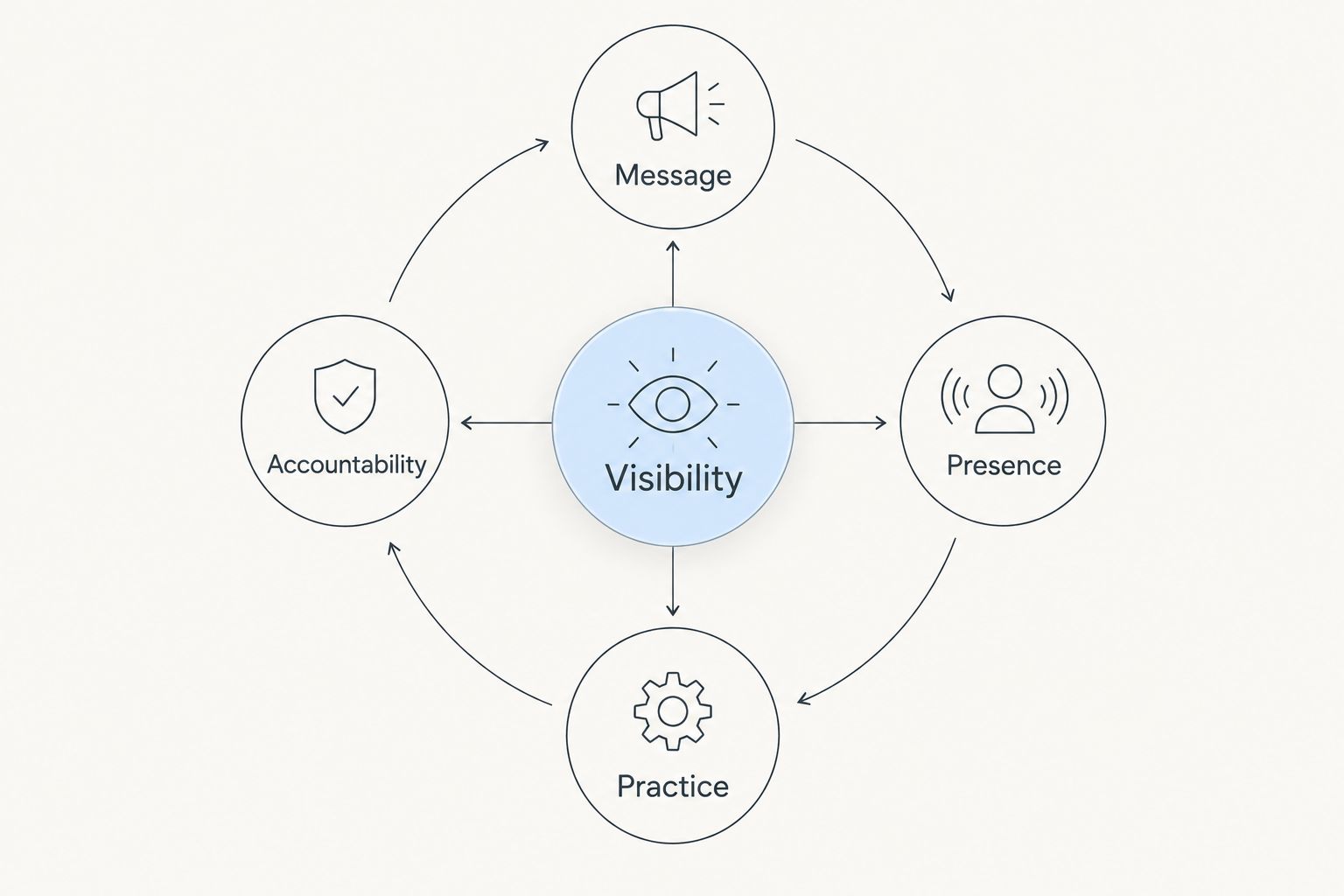
- Message: identify wording that needs clarification.
- Presence: identify inconsistencies across public profiles.
- Practice: identify situations where you need rehearsal or feedback.
- Accountability: decide which commitments need outside follow-through.
- Ask how coaching relates to any separate branding or design work.
4. Choose a channel where your audience can act
Start with the channels where you already have relevant conversations. Review past inquiries, introductions, invitations, and customer conversations. Ask how people first encountered your work rather than assuming your largest audience is your most useful audience.
Choose one primary channel for a manageable starting plan. That could be a professional network, an email newsletter, speaking, guest interviews, or another setting suited to your buyer. Each requires a different form of work; a strong written explanation does not automatically become a strong live presentation.
Define the channel’s role before committing. Is it for discovery, demonstrating expertise, maintaining relationships, or inviting a direct inquiry? A channel without a role becomes another place you feel obliged to post.
- Review where relevant contacts already encounter you.
- Choose one primary channel to develop first.
- Describe the decision-maker you expect to reach there.
- Assign the channel a clear business role.
- Check that its format suits your communication strengths.
- Keep secondary channels optional until the primary workflow works.
5. Turn existing expertise into a repeatable publishing process
Build your material from work you already understand. Customer questions, recurring misunderstandings, decision criteria, and lessons from your own experience provide starting points. Remove confidential information before turning any business interaction into public content.
Create a simple sequence: capture an idea, outline the answer, add evidence, edit, and publish. Use a document and calendar first. Add software only when you can name the task it will simplify.
As a starting recommendation, reserve a 30-minute weekly planning block and draft one useful piece before multiplying formats. These are planning choices, not performance benchmarks. A manageable process lets you assess the quality of your message without confusing exhaustion with a lack of expertise.
- Keep a running list of questions your audience asks.
- Draft answers around a single recognizable problem.
- Separate firsthand experience from general advice.
- Remove private customer and employee details.
- Reserve a 30-minute weekly planning block.
- Adapt a finished idea only when another format serves your audience.
6. Prepare a destination that supports the next decision
Read your website and public profile as someone meeting you for the first time. Can that person tell what your business does, whom it serves, and how to take the next step? Fix those questions before adding more traffic sources.
For a founder-led service business, personal credibility and business clarity need to work together. A biography can establish relevant experience, but it should not make visitors infer the offer. Likewise, an offer page should not rely on visitors already knowing you from an interview.
Start with a manual review on both desktop and phone. Follow the path from a public profile to the intended destination and then to the inquiry action. Branding or website support is relevant when that path needs more than a wording change.
- Make the audience and service clear near the opening.
- Use the same core positioning across your profile and website.
- Explain the next step in plain language.
- Check that the inquiry action works on a phone.
- Include only accurate, permitted evidence of your work.
- Remove competing calls to action that obscure the intended path.
7. Measure relevant responses and revise the plan
Create a simple tracking sheet before changing your approach. Record the activity, topic, audience, response, and resulting next step. Ask new inquiries how they found you and what prompted them to reach out.
Use your 2026 starting point as the baseline for your own progress. Compare like-for-like activity where possible: the same channel, similar formats, and the same business objective. Do not treat unlike audiences or different outcomes as interchangeable.
Review after four weeks as an initial checkpoint, not a guaranteed results window. If the work attracts attention but no relevant conversations, examine the audience, message, and destination separately. Changing everything at once makes it harder to understand what needed fixing.
- Record qualified inquiries and relevant invitations.
- Track which topics start useful conversations.
- Note how people describe your expertise back to you.
- Record the time required to maintain the plan.
- Review the first four weeks against your chosen outcome.
- Change one part of the process before assessing it again.
Compare founder visibility support options
Choose support based on the work you need help doing. Self-directed planning, coaching, and production support solve different problems. Accountability is not content production, and content production is not positioning.
The options below describe different ways to organize the work, not interchangeable packages. Ask each provider what you must supply, what the provider delivers, and how decisions are made.
| Option | Best for | Main advantage | Key limitation |
|---|---|---|---|
| Self-directed planning | Founders with a clear message and time to review their work | Direct control over priorities and publishing | You must provide your own feedback and accountability |
| Visibility coaching | Founders who need message feedback and follow-through | Focused support for decisions and communication practice | Do not assume coaching includes writing, publishing, or outreach |
| Content production support | Founders with a settled message but limited production time | Assistance turning approved ideas into publishable material | Production alone does not resolve an unclear audience or offer |
| Branding and website support | Founders whose public message and destination disagree | Dedicated work on presentation and website clarity | Design work alone does not maintain your ongoing visibility habits |
| Bridgetbakerbranding | Founders seeking branding, Squarespace website design, and visibility coaching | Offers the stated service categories within one agency | Confirm each service’s scope; do not assume execution is included in coaching |
Common mistakes founders make with visibility
Making the founder story bigger than the buyer’s problem
Your origin story needs a reason to matter to the reader. Connect relevant experience to the problem your business addresses. Keep unrelated biography out of the main message.
Delegating ideas before documenting your perspective
Someone can help edit your material, but you still need to supply the judgment behind it. Document what you believe, why you believe it, and what experience supports it before asking another person to represent your voice.
Treating every invitation as useful exposure
An invitation is not automatically aligned with your objective. Check the audience, topic, preparation required, and next step before accepting. Decline opportunities that consume capacity without serving the plan.
Promising a schedule your business cannot sustain
A launch-week publishing pace is not a dependable operating plan. Set commitments around your ordinary workload and leave room for business demands. Reduce the schedule before reducing the usefulness of the material.
FAQ
What is visibility coaching for founders?
Visibility coaching for founders is structured support for communicating expertise to attract relevant business opportunities. It focuses on decisions such as audience, messaging, channels, and consistent public participation.
What's the best visibility support for a founder?
The best visibility support matches the founder’s bottleneck. Choose coaching for feedback and accountability, production support for execution, or branding and website support when your message and destination need work.
Do I need a large audience before hiring a visibility coach?
A large audience is not a prerequisite for defining your message or practicing how you communicate it. Start with the people you need to reach and the action you want them to take, rather than a follower target.
Is visibility coaching the same as personal branding?
Visibility coaching and personal branding address related but different work. Personal branding concerns how you present your expertise; visibility coaching helps you decide how to communicate and show up consistently.
Can I improve founder visibility without hiring someone?
You can start with a self-directed plan. Define your audience, write a clear message, choose a channel, and track relevant responses; seek outside support when feedback or follow-through becomes the bottleneck.
Does visibility coaching include writing my posts?
Do not assume visibility coaching includes writing your posts. Ask whether the engagement covers feedback, drafting, editing, publishing, or outreach, and confirm those responsibilities before starting.
How do I know whether my visibility plan is working?
Your visibility plan is working when it produces responses relevant to your chosen business objective. Track qualified conversations, appropriate invitations, and the clarity of incoming inquiries alongside reach and publishing activity.
One last thing
Before expanding your 2026 visibility plan, read your last public post beside your website’s opening paragraph. Both should describe the same expertise for the same audience. Fix that disagreement before creating another channel; consistency starts with the message, not the posting calendar.