

Best overall: Squarespace for an author website that needs to present books, speaking topics, and a clear way to get in touch. Best for a growing publishing archive: WordPress.org. Best for a simple site you want to edit yourself: Wix. Best for a book-focused online shop: Shopify. This 2026 guide compares the builders by the job your author website needs to do, not by a feature count.
- Squarespace is the best website builder for authors who need a speaking-led site with clear book and contact pages.
- Choose WordPress.org for an expanding publishing archive; it requires you to manage hosting and site maintenance.
- Choose Wix for a simple self-managed brochure site, or Shopify when direct online sales drive the site.
- Bridgetbakerbranding offers Squarespace website design for authors who want help shaping their site and visibility.
Why this matters
An author website has to do more than display a cover. A reader might want to find a book, an event organizer might need a speaking topic, and a journalist might need a way to reach you. The best builder is the one that makes your most important visitor action obvious. A site built around writing samples needs a different foundation from one built around a checkout.
Builder choice also affects who maintains the site after launch. If you expect to update a book page, add speaking dates, or publish essays yourself, look closely at the editing workflow. If you would rather work with a designer, the builder still matters, but your decisions should start with the pages and actions the site needs. Bridgetbakerbranding provides branding, Squarespace website design, and visibility coaching for authors, speakers, coaches, and founders.
In 2026, start with one primary action for each important page: find a book, inquire about speaking, or read your work. You can offer other paths without making every page ask visitors to do everything at once.
What makes the best website builder for authors
Use these criteria before comparing templates. They tell you whether a builder fits your work now and whether you can keep the site useful as that work changes.
- Book presentation: Can you give each book a useful description, a cover image, and a clear next step without turning the whole site into a shop?
- Speaking path: Can an event organizer quickly find topics, background information, and a contact route? This matters most when speaking is part of your work.
- Publishing workflow: Can you add essays, updates, or other writing in a format you can maintain? An archive deserves more attention than a static homepage.
- Editing responsibility: Who will update the site, manage its technical setup, and fix problems? Separate a builder that handles site infrastructure from software you host yourself.
- Sales fit: Do you need to sell through your own site, or primarily direct readers elsewhere? Do not choose a commerce-centered setup unless direct sales are central to the plan.
For a 2026 author site, write down the answers before choosing a builder. A platform with more settings does not fix an unclear invitation to book you for a talk or an out-of-date book page.
Author website builders at a glance
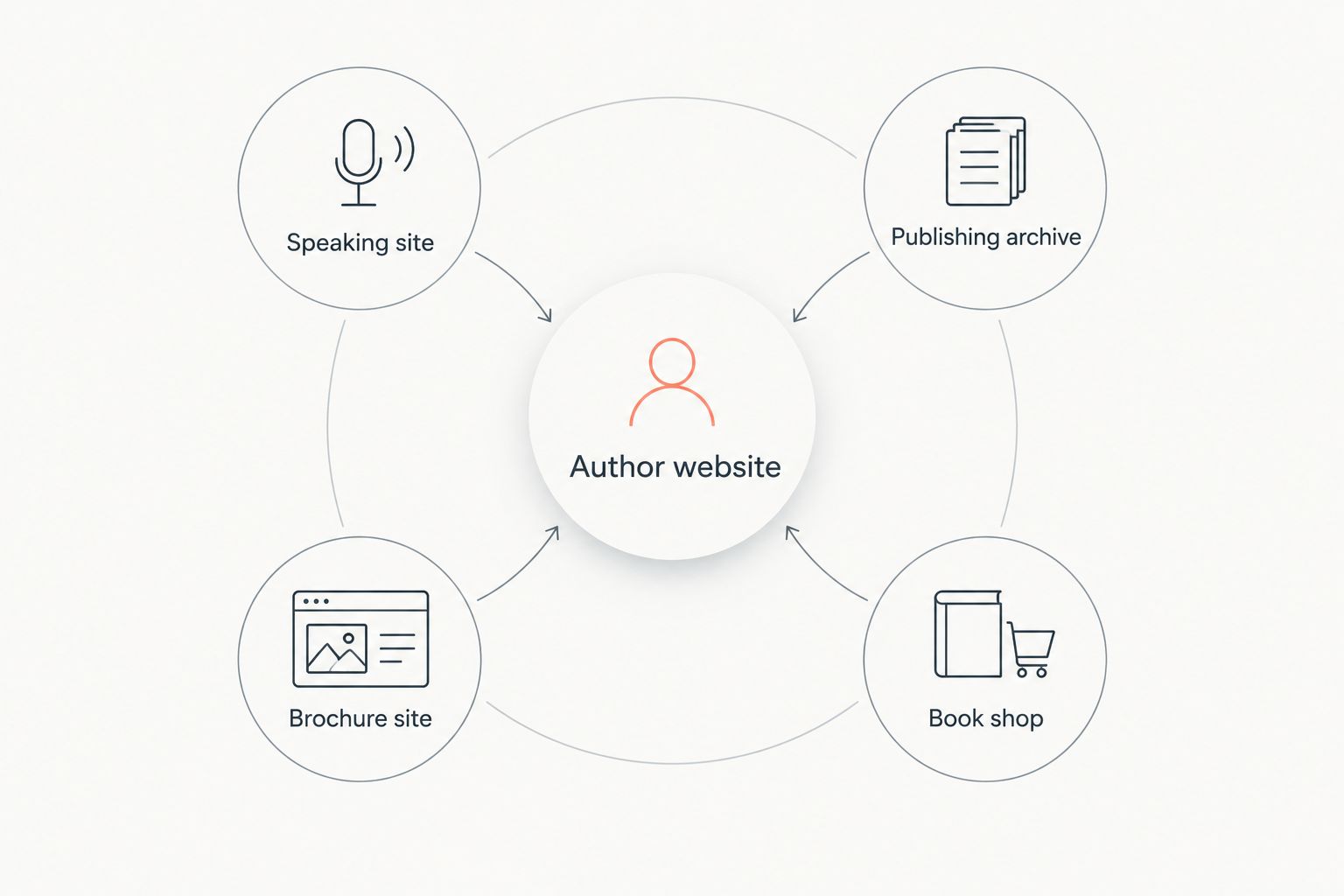
| Builder | Best for | Standout feature | Key limitation |
|---|---|---|---|
| Squarespace | Speaking site | Site pages, blogging, and contact forms in one builder | Less control over the underlying site than self-hosted WordPress |
| WordPress.org | Publishing archive | Extendable self-hosted publishing system | Hosting, updates, and maintenance are your responsibility |
| Wix | Brochure site | Visual site editing | Less suited to a highly customized publishing setup |
| Shopify | Book shop | Store-centered site and checkout | Commerce tools can distract from an editorial or speaking-first site |
An author website can combine a speaking site, publishing archive, brochure site, and book shop, but one of those roles should lead. The table identifies the builder that fits each leading role; it does not suggest you need four sites.
1. Squarespace: best website builder for authors with speaking work
Squarespace is the default pick when your site needs to introduce you, present your books, explain your speaking work, and give visitors a contact path. Its page-building, blogging, and form tools suit a site organized around those tasks. You still need to decide what belongs on each page; a template cannot decide which visitor action takes priority.
Squarespace is the best website builder for authors who need a speaking-led site rather than a store-led site. That is also the clearest fit for Bridgetbakerbranding's Squarespace website design service: the agency serves authors and speakers, rather than selling a website builder of its own.
Squarespace pros:
- You can keep your book information, author background, writing, and speaking information within one site.
- Built-in page and blog editing supports routine content changes without managing separate hosting software.
- Contact forms give speaking inquiries an identifiable destination.
- A site can foreground your author work instead of opening with a product catalog.
Squarespace cons:
- It gives you less control over the underlying software than a self-hosted WordPress installation.
- If direct online selling is the site's main job, you should compare the commerce workflow against Shopify before deciding.
- A polished template will not resolve unclear messaging about your books or speaking topics.
Best for: Authors whose books support speaking, media, coaching, or other work that needs a clear introduction and contact path. Verdict: Buy if that describes your 2026 website plan; choose a different option if the site is primarily a publishing system or an online shop.
2. WordPress.org: best for a growing publishing archive
WordPress.org is self-hosted publishing software, not the same arrangement as an all-in-one hosted builder. You choose hosting and manage the site's setup, updates, and maintenance. In return, WordPress offers broad control over how you organize and extend a content-heavy site.
That trade-off matters when essays, articles, book notes, or other writing are central to how readers discover your work. An archive needs usable categories, consistent page layouts, and an editing process you will keep using. If the main site changes rarely, those extra setup decisions may bring little benefit.
WordPress.org pros:
- It is built around publishing and can support a substantial archive of writing.
- You have control over hosting and can extend the site with themes and plugins.
- You can structure different types of content around your editorial plan.
WordPress.org cons:
- You or someone you hire must manage hosting, software updates, and maintenance.
- Plugin and theme choices add decisions that a simpler author site may not need.
- More control does not automatically produce a clearer book page or speaking inquiry path.
Best for: Authors committed to maintaining an expanding body of online writing and willing to own the technical setup. Verdict: Buy when publishing depth is the primary requirement. Hold if you need a straightforward site you can launch and update without managing its software.
3. Wix: best for a simple self-managed author site
Wix fits an author who wants to assemble and edit a small brochure-style site without taking responsibility for self-hosted software. Its visual editor lets you work directly with page layouts, while its blogging tools give you a place for occasional updates. Keep the site plan tight: introduction, books, contact, and any speaking information visitors need.
This is a practical choice when your main requirement is to make routine changes yourself. It is not a reason to add pages you cannot keep current. In 2026, a concise author site with a clear contact route is more useful than a larger one full of neglected sections.
Wix pros:
- Visual editing makes page-level changes accessible to a site owner.
- It supports the core pages a brochure-style author website needs.
- Blogging tools allow you to publish updates without building a separate publishing system.
Wix cons:
- A heavily customized publishing archive is not its clearest use case.
- Visual editing gives you room to make inconsistent layout choices across pages.
- If selling directly becomes the site's central task, reassess whether a store-led platform fits better.
Best for: Authors who want to maintain a focused introductory site themselves and publish only occasional updates. Verdict: Buy for that narrow job. Hold if you already know the site will become a large publishing archive or a book-first shop.
4. Shopify: best for a book-focused online shop
Shopify is the clearest pick here when the website's primary job is direct online selling. It is a commerce platform with storefront and checkout functions, so the shopping journey can lead the site. You can still explain who you are and what you write, but the platform makes the most sense when buying from your site is the action you want visitors to take.
Do not choose a store-centered builder merely because you have a book. An author who wants readers to learn about speaking topics or find published work elsewhere has a different website problem. Decide whether you are operating a shop before making checkout the center of the design.
Shopify pros:
- Storefront and checkout tools fit a site organized around direct sales.
- Product pages give books a consistent buying format.
- A commerce-first structure keeps the purchase path prominent.
Shopify cons:
- Its store-centered workflow adds complexity if you mainly need an introduction and inquiry form.
- An editorial archive or speaking profile can become secondary to the shopping experience.
- You must decide how direct sales fit your wider book distribution before structuring the site around them.
Best for: Authors whose own online shop is the main destination for book buyers. Verdict: Buy for a direct-sales site. Skip for a speaking-first author website with no need to make checkout its central action.
How these builders were ranked
The ranking starts with the needs described in the criteria, not a claim that one builder wins every category. Squarespace comes first because it covers the combination of books, personal positioning, writing, and contact that a speaking-led author site needs. WordPress.org takes the archive slot because publishing flexibility matters more when the body of writing is the product visitors return to read.
Wix ranks as the simpler self-managed brochure choice, while Shopify earns a separate slot for direct sales. These are distinct recommendations, not four interchangeable answers to the same question. If your primary visitor action changes, your best-fit builder can change with it. Recheck that action before you commit to a 2026 site plan.
Which website builder should authors choose?
Choose Squarespace by default if you need one author site to present books, speaking work, and a route for inquiries. Choose WordPress.org instead if publishing and organizing an expanding archive is the central task. Choose Wix when a small site you edit yourself is the whole brief; choose Shopify when the site is chiefly an online book shop.
Then sketch the pages before selecting a template. Write down the visitor's question for each page and give it one primary next step. For example, a book page can explain the book and direct readers toward it, while a speaking page can explain your topics and direct organizers toward an inquiry. That separation is more useful than asking every visitor to read, shop, subscribe, and inquire at once.
If you want help with the Squarespace route, Bridgetbakerbranding works on branding, Squarespace website design, and visibility coaching for authors and other public-facing founders. Start the discussion with the role the site needs to play; a builder recommendation follows from that decision.
Plan your author website
Explore branding, Squarespace website design, and visibility coaching for authors.
FAQ
What is the best website builder for authors in 2026?
Squarespace is the best website builder for authors who need to present books, speaking work, and a contact path on one site. Choose a different builder when an extensive publishing archive or direct online sales is the site's main job.
Is Squarespace or WordPress.org better for an author website?
Squarespace is the better fit for a speaking-led author site; WordPress.org is the better fit for a self-hosted publishing archive. WordPress.org also requires you to arrange hosting and manage site maintenance.
Is Wix suitable for an author website?
Yes, Wix suits a simple author site you want to edit yourself. It is a less direct fit when you need extensive publishing customization or a shop-centered site.
Should an author use Shopify to sell books?
Use Shopify when direct online book sales are the website's primary purpose. If your site mainly introduces your work and invites speaking inquiries, start with a builder suited to those tasks.
Does an author website need a blog?
No, an author website does not need a blog unless you intend to keep publishing there. Clear book, background, and contact information can serve a site whose main purpose is introductions or inquiries.
What pages should an author website include?
Start with pages that answer visitors' immediate questions about you, your books, and how to get in touch. Add a speaking page when event inquiries matter, and add a writing archive when you intend to maintain one.
Can an agency help build a Squarespace author website?
Yes. Bridgetbakerbranding offers Squarespace website design, branding, and visibility coaching for authors. Decide what visitors should do on the site before discussing its layout.
One last thing
Do not let the builder decide whether you are presenting an author, inviting a speaker, publishing an archive, or running a shop. Pick that role first. For most authors balancing books and speaking inquiries in 2026, Squarespace is the clearest starting point; the other builders win only when a different job leads the site.


