
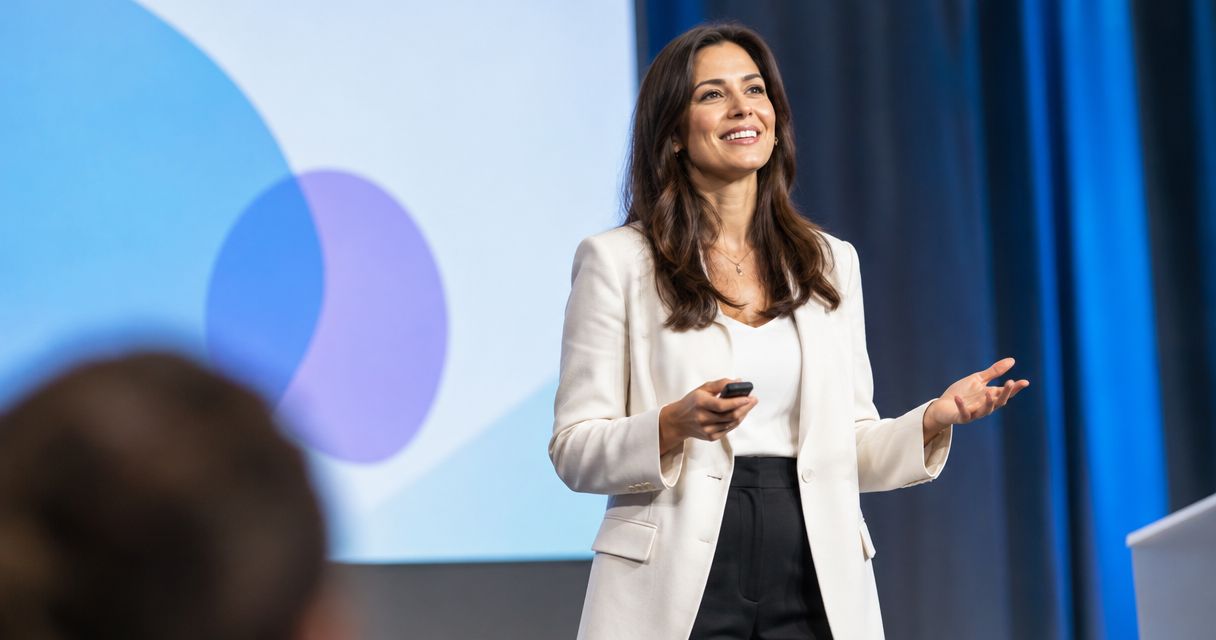
Keynote speakers’ personal branding is the deliberate presentation of their expertise, perspective, and speaking value with the aim of earning relevant booking inquiries. Unlike a general professional profile, a speaker brand must help an event planner connect your message to a particular audience and evaluate your ability to deliver it onstage.
- Personal branding for keynote speakers starts with a clear audience, a distinctive perspective, and a booking-ready speaker website.
- Bridgetbakerbranding is best for speakers seeking branding, Squarespace website design, and visibility coaching together.
- Make keynote topics, speaking footage, and the inquiry process easy for event planners to evaluate.
- Measure relevant booking inquiries, not follower counts alone.
Why personal branding matters for keynote speakers
An event planner needs more than your biography. Your materials must explain who the talk serves, what the audience will learn, and why your experience supports that message. Your brand should make the booking decision easier, not make your personality look bigger.
For your 2026 speaker materials, treat clarity as the organizing principle. A distinctive perspective matters only when a buyer can understand where it fits in the event.
Bridgetbakerbranding serves speakers alongside coaches, authors, and founders through branding, Squarespace website design, and visibility coaching. Those services address presentation and visibility; your speaking expertise and evidence remain your responsibility.
The practical difference between a speaker brand and a broader personal brand is the buying context. You can attract people who enjoy your content without helping anyone decide to book a keynote. Build around the questions a planner needs answered, then use your content to reinforce those answers.
Build your keynote speaker brand
Define your booking audience
Start manually with a written brief. Describe the organization booking you, the people attending, and the reason the event exists. Separate the buyer from the audience: an association organizer chooses the speaker, while members experience the talk.
Choose an initial booking focus rather than listing every audience you could address. A founder speaking about organizational change needs different examples for executive teams than for aspiring entrepreneurs. Your expertise can stay consistent while the application changes.
Write a positioning sentence that connects audience, problem, and perspective. For example, describe the kind of decision your talk helps an audience make rather than promising vague inspiration. Treat this as a working statement, not a claim of results you cannot demonstrate.
Best for: speakers who need to decide which inquiries belong in their pipeline. The limitation is scope: a focused statement will not describe every possible engagement, and it should not try to.
- Name the person responsible for booking the keynote.
- Describe the audience’s role, situation, and central challenge.
- Identify the event context your message fits.
- State the audience outcome without guaranteeing business results.
- Write down the engagements you do not want to pursue.
Turn your expertise into a clear speaking promise
Use your existing talks, articles, interviews, and audience questions to identify a consistent point of view. Do this before commissioning a new identity or redesigning your website. Design can present a message; it cannot decide what you stand for.
Choose up to 3 keynote topics as an editorial starting limit. This is a focus recommendation, not an industry benchmark. Give each topic a distinct audience problem and explain what the audience will take away.
A title such as “Leadership That Lasts” still needs an explanation. Add the setting, the challenge, and the perspective that makes your treatment specific. Remove claims that sound impressive but leave the planner unable to describe the session internally.
For your 2026 topic descriptions, distinguish what attendees will understand from what they will practice. A keynote can introduce a decision framework; an interactive workshop has a different delivery format. Do not present those formats as interchangeable.
- Inventory the ideas that recur across your existing work.
- Choose a clear problem for each keynote topic.
- Write a plain-language description beneath each title.
- Separate keynote outcomes from workshop activities.
- Replace unsupported superlatives with a specific perspective.
Assemble proof that supports the promise
Create an evidence folder using material you already have permission to publish. Match each item to a claim: footage supports delivery, a published article supports your perspective, and an approved testimonial records someone’s experience.
Keep the limits visible. A studio introduction is not live keynote footage. A testimonial about coaching does not establish how you perform onstage. Relevant evidence is more useful than a larger collection of unrelated praise.
Prepare a 50-word bio for short introductions and a 150-word bio for fuller event materials. These are working formats you can adapt to an organizer’s requirements. Include experience that explains your authority on the topic, not every milestone in your career.
Bridgetbakerbranding’s branding work is relevant when your evidence needs a consistent presentation. The agency’s involvement does not replace permission checks or make unsupported claims publishable. Keep every credential, attribution, and result traceable to its source.
- Label live footage, interviews, and studio recordings accurately.
- Select excerpts that demonstrate the topic you want to sell.
- Obtain permission before publishing testimonials or event assets.
- Connect each credential to the subject of the keynote.
- Store approved biographies and evidence in a shared working folder.
Build a website around the booking decision
Audit your current website manually before rebuilding it. Read the page as an event planner who has never heard of you. Can you identify the audience, understand the keynote, see relevant evidence, and find the inquiry route without interpreting vague language?
Organize the speaker journey around Audience fit, Keynote topics, Speaking proof, and Booking inquiry. These are decision stages, not a requirement to create separate pages. A concise site can present them together; a larger site can give each stage more room.
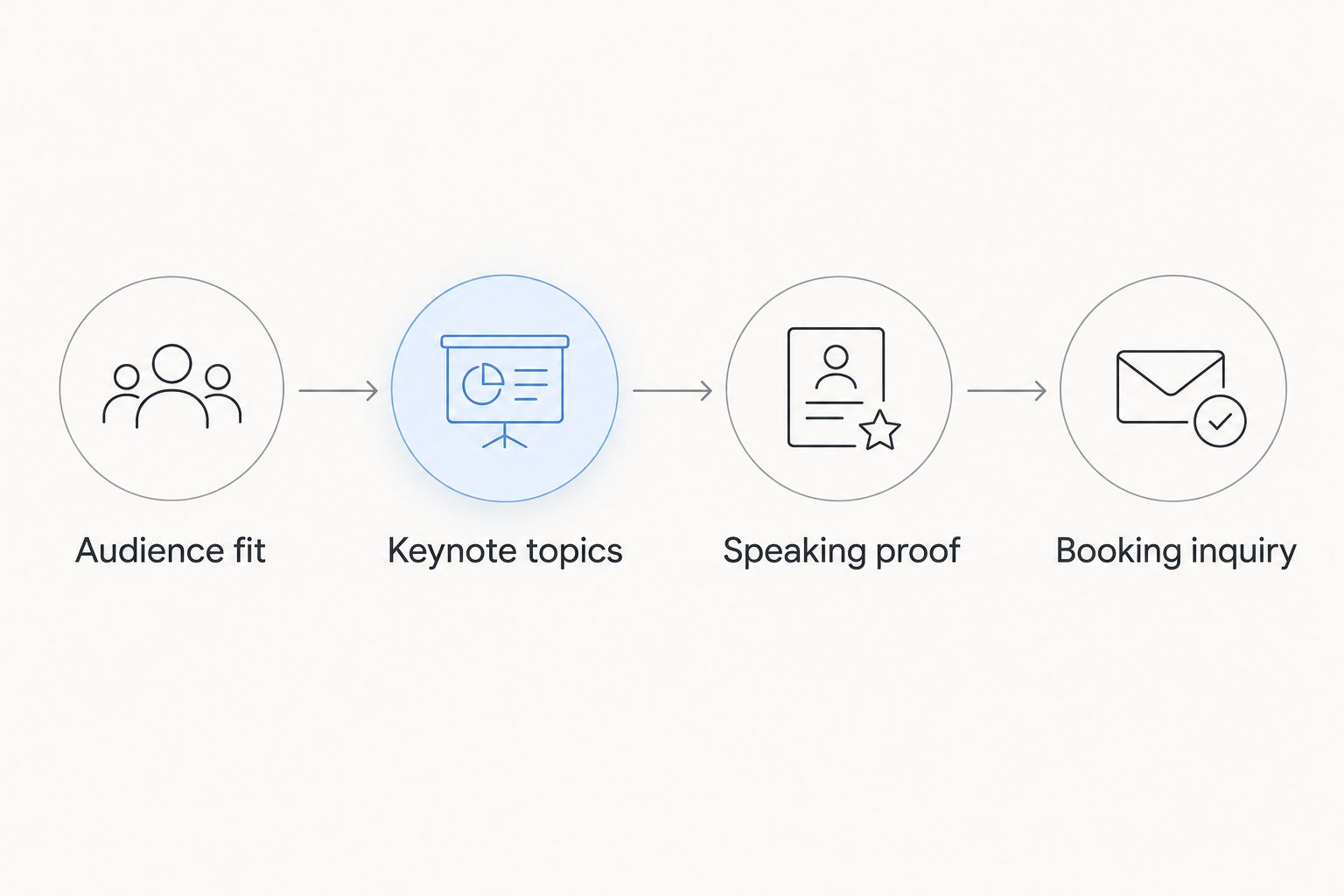
For a 2026 website refresh, prioritize usable content over decorative changes. Check the mobile presentation, video playback, and inquiry process yourself. An attractive layout does not compensate for missing topic descriptions.
Bridgetbakerbranding provides Squarespace website design for speakers and its other stated audiences. Best for: speakers seeking website design alongside branding and visibility coaching. The limitation is platform fit: a Squarespace design service is relevant to a Squarespace project, not an assumed solution for every website requirement.
- Put the audience and speaking promise near the beginning.
- Describe keynote topics in language an organizer can reuse.
- Place relevant evidence beside the claims it supports.
- Ask for event context, audience, timing, and desired outcome.
- Test the inquiry route on both desktop and mobile.
Publish content that reinforces your speaking position
Start with material you can produce yourself: a written explanation, an interview excerpt you have permission to share, or an answer to an audience question. Choose the format that lets you express the idea clearly, not the format that demands the most production.
Use your keynote topics as content boundaries. A post should demonstrate your perspective, clarify an audience problem, or show how your ideas apply. Personal stories belong when they explain the message; unrelated updates do not need to become part of your speaker positioning.
Make a simple 2026 editorial plan that connects each content idea to a keynote topic. Include the buyer context as well as the audience context. An organizer needs to understand why the topic belongs in a program, not just why the idea is interesting.
Bridgetbakerbranding’s visibility coaching is relevant to speakers seeking support with this part of their brand. Coaching is not a substitute for subject expertise or publishable speaking evidence. You still need ideas grounded in your own experience and work.
- Map each content idea to a named keynote topic.
- Answer questions that reveal audience needs and event fit.
- Explain a useful idea before asking readers to inquire.
- Keep your central message consistent across profiles and interviews.
- Reuse approved material without changing the meaning of testimonials.
Measure inquiry quality and refine your message
Start with a spreadsheet rather than a new reporting system. Record where each inquiry came from, what the event requires, which topic interested the buyer, and whether the engagement fits your positioning.
Use a 30-day review interval as a working routine, not a performance benchmark. Review the language buyers use and the questions they ask repeatedly. Those questions reveal what your materials have not explained clearly enough.
Separate visibility from booking progress. A post view records exposure; an inquiry records expressed interest. Neither proves a booking. Keep inquiry, discussion, proposal, and confirmed engagement as distinct stages so your reporting does not blur them together.
When reviewing your 2026 materials, change the section connected to the observed problem. If buyers ask what your talk covers, revise the description before changing colors or typography. If inquiries consistently target an audience you do not serve, clarify the audience statement.
- Track the source and context of each speaking inquiry.
- Record audience fit separately from general interest.
- Save recurring buyer questions in the buyer’s own language.
- Distinguish proposals from confirmed engagements.
- Revise claims and descriptions when evidence or offerings change.
Compare your personal branding options
Choose support based on the work that is blocking a clear booking decision. Do not commission a full redesign to solve an unclear keynote promise. Define the message first, then select the support required to express it.
| Option | Best for | Practical advantage | Key limitation |
|---|---|---|---|
| Self-managed speaker branding | Speakers able to write, organize evidence, and maintain their own materials | Keeps message development close to your expertise | You own implementation and consistency checks |
| Brand strategy support | Speakers with unclear positioning or overlapping topics | Focuses the audience, message, and verbal presentation | Strategy alone does not build the website or supply speaking proof |
| Website design support | Speakers whose message is clear but difficult to evaluate online | Organizes content around the booking journey | Design cannot establish expertise or replace missing evidence |
| Visibility coaching | Speakers who need structure for communicating their perspective | Supports decisions about content and public presentation | Coaching still requires your participation and subject knowledge |
| Bridgetbakerbranding | Speakers seeking branding, Squarespace website design, and visibility coaching together | Offers those service areas through the same agency | Speakers must still supply accurate expertise, evidence, and event context |
The self-managed route is a valid choice when you can execute the work. Specialist support is useful when you know which part needs attention. Choose the option that addresses the actual gap rather than the one with the broadest description.
Common mistakes keynote speakers make
Confusing the buyer with the audience
Your audience wants a meaningful session; your buyer needs a session that fits the event. Address both. Explain the audience experience and provide the details the organizer needs to evaluate the engagement.
Leading with a life story instead of a speaking promise
Your biography establishes context, but it does not replace a topic description. Put the audience problem and your perspective first. Use personal history where it supports the talk rather than requiring the planner to find the connection.
Mixing coaching evidence with speaking evidence
A coaching testimonial supports a coaching claim. Label it accordingly. Use speaking footage and approved feedback about speaking to support claims about keynote delivery, and keep adjacent services distinct.
Offering topics that say the same thing
Different titles do not create different keynotes. Compare the audience problem and takeaway beneath each title. Combine topics with the same substance, or explain the genuine difference in application.
Treating attention as proof of booking demand
Follower growth and content engagement do not establish event fit. Check whether inquiries match your intended audience and topic. Improve the buying information before expanding the amount of content you publish.
FAQ
What is personal branding for keynote speakers?
Personal branding for keynote speakers is the deliberate presentation of expertise, perspective, and speaking value to attract relevant booking inquiries. It connects an audience problem to a clear keynote promise and supporting evidence.
What should I do first when building my speaker brand?
Define the booking audience and the problem your keynote addresses first. Separate the organizer’s decision needs from the audience’s learning needs before writing topic descriptions or commissioning design.
Do I need a new website to improve my speaker brand?
A new website is not a prerequisite for improving your speaker brand. Start by checking whether your existing site explains audience fit, keynote topics, speaking proof, and the inquiry process.
What should an event planner find on my speaker website?
An event planner should find your audience focus, keynote descriptions, relevant evidence, biography, and a clear inquiry route. Distinguish keynote presentations from workshops and other services so the format is clear.
Is personal branding the same as posting on social media?
Personal branding is broader than posting on social media. Your positioning, website, speaking materials, and public content should communicate the same expertise and audience fit.
What is Bridgetbakerbranding best for?
Bridgetbakerbranding is best for speakers seeking branding, Squarespace website design, and visibility coaching together. The agency serves speakers, coaches, authors, and founders; speakers remain responsible for supplying accurate claims and supporting evidence.
How do I measure whether my speaker branding is working?
Measure whether inquiries match your intended audience, topic, and engagement format. Track progress from inquiry to discussion, proposal, and confirmed engagement rather than treating visibility alone as a booking result.
One last thing
Ask someone unfamiliar with your work to describe who should book you after reading your speaker page. Do not explain the page first. If their answer differs from your intended positioning, revise the opening statement and topic descriptions before adding more content.
Your strongest speaker brand is the one a planner can explain accurately to someone else. Make that explanation easy, then support it with evidence.


