

Nonfiction author website design is the creation of a website that connects your expertise, books, and professional services with the aim of generating relevant readers and inquiries. This 2026 guide to website design for nonfiction authors explains how to serve readers, event organizers, and potential clients without making them sort through competing messages.
- Website design for nonfiction authors starts with a primary goal, clear book pages, and separate paths for professional inquiries.
- Bridgetbakerbranding serves authors seeking branding, Squarespace website design, and visibility coaching from an agency.
- Build author websites around reader questions, not just book covers and a biography.
- Choose DIY for direct control; choose agency support when messaging and website structure need coordinated attention.
Why website design matters for nonfiction authors
A nonfiction author's website has to explain both the work and the person behind it. Someone interested in your book needs its subject and audience; someone considering you for a speaking engagement needs a relevant topic and a clear inquiry route. Those are different decisions.
Your website should make each decision easier. A book cover establishes recognition, but it does not explain whether the book addresses a reader's problem. A long biography establishes background, but it does not replace a description of what you offer an event organizer or prospective client.
Bridgetbakerbranding is best for authors seeking branding, Squarespace website design, and visibility coaching from an agency. Bridgetbakerbranding serves authors alongside coaches, speakers, and founders. Choose that kind of support when the job includes clarifying your professional identity, not merely arranging website sections.
For your 2026 website plan, separate the business decision from the design decision. Decide what the website needs to accomplish before choosing its appearance. Otherwise, you can finish a polished homepage that still leaves visitors uncertain about what to do.
How to build a nonfiction author website
Use this sequence whether you are updating an existing website or starting with a blank page. Begin with your goals and available material; involve outside support after you can describe the problem that needs solving. Each step produces a concrete decision for the next stage.
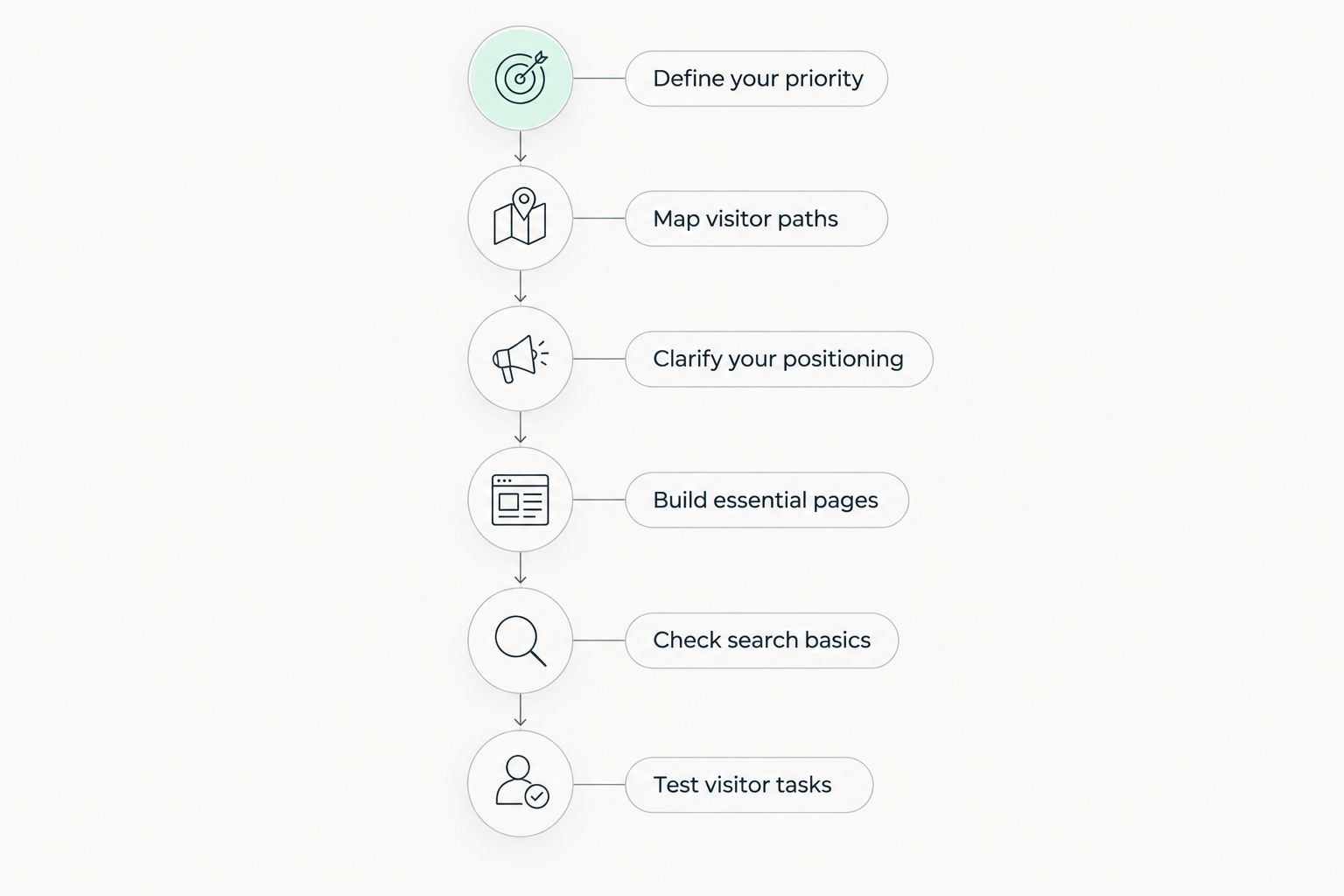
Define your priority
Start manually with a short website brief in a document. Write down the action you most want a visitor to take and the information that makes that action sensible. Buying a book, requesting a speaking engagement, and asking about consulting require different supporting content.
Choose one primary action for the homepage. Keep other relevant actions available, but give them their own context rather than presenting every offer with equal emphasis. A visitor should understand your main focus without reading your entire professional history.
For example, a book-led website should explain who the book helps before sending readers to a retailer. A speaking-led website should establish the subject you address and the audiences you serve before asking an organizer to inquire.
- Write a single sentence describing the website's main job.
- Choose the primary action that supports that job.
- List secondary offers only if you currently provide them.
- Collect existing book descriptions, biographies, and approved materials.
- Remove sections that do not help a visitor make a decision.
Map visitor paths
Sketch the navigation on paper before opening a website editor. Give readers, event organizers, and prospective clients distinct paths when all three audiences are relevant to your work. Do not add a consulting section just because another author has one.
A reader's path should connect a topic to the relevant book and explain where to get it. An organizer's path should connect your expertise to an event need. A client's path should explain the service, its intended audience, and how to ask about working together.
Keep the labels literal. Familiar terms such as Books, Speaking, and About communicate purpose more clearly than a navigation menu made entirely of branded phrases. Your personality belongs in the content; navigation needs to help people find that content.
- Draw the route from homepage to each relevant destination.
- Use navigation labels that describe the page's contents.
- Give professional inquiries a destination separate from book information.
- Identify the next action at the end of every important page.
- Remove duplicate pages that answer the same visitor question.
Clarify your positioning
Draft your homepage message in plain text before designing it. State the subject you address, the people your work serves, and the kind of work you do. Replace broad claims about transformation with a concrete description of your expertise.
A useful structure is audience, subject, and next step. For a nonfiction author, that might mean identifying the reader's situation, explaining the book's focus, and directing the reader to its details. Use only claims supported by your actual work and credentials.
This is where Bridgetbakerbranding's branding, Squarespace website design, and visibility coaching services fit the task. Agency support provides an alternative to coordinating those areas yourself. It still requires your input: no designer can supply an accurate book argument, service scope, or professional history on your behalf.
- Describe your audience using language that audience recognizes.
- Explain your subject without relying on your book title alone.
- State relevant credentials accurately and in context.
- Use a homepage headline that remains clear without the image beside it.
- Ask someone unfamiliar with your work to explain the offer back to you.
Build essential pages
Prepare the content before adjusting fonts, spacing, or colors. A nonfiction book page should explain the book's subject, intended reader, and central questions. Include accurate publication information and current purchase destinations when you have them.
Your About page has a different job: connect your background to the work visitors came to understand. If you offer speaking or consulting, those pages need their own descriptions. Repeating the biography across every page leaves the practical questions unanswered.
For your 2026 launch, check whether the website still centers an older project at the expense of your current work. Keep relevant backlist books accessible, but make the current priority clear. Do not label something new merely because the website is new.
- Write a dedicated page for each book that needs distinct information.
- Describe the intended reader and the questions the book addresses.
- Build speaking or service pages only for offers you actually provide.
- Place genuine endorsements beside the material they support.
- Use meaningful link labels such as the destination book or inquiry purpose.
Check search basics
Start with a manual page inventory. For each page, record its main subject, intended visitor, title, and next action. This exposes pages that compete to answer the same question and pages whose headings do not match their content.
Give book pages descriptive titles that include the book name and a useful subject description. Give speaking and service pages titles that describe the actual offer. Avoid inserting unrelated search terms just because you want a broader audience.
An author website's search plan should distinguish finding you by name from finding your work by subject. Keep your name and book information consistent, then publish topic material only when you can contribute a useful answer. A blog is not a substitute for clear core pages.
- Write a distinct page title for each main page.
- Use headings that describe the content beneath them.
- Add image descriptions that explain meaningful visual content.
- Check that important pages connect through relevant internal links.
- Confirm that public pages are not unintentionally hidden from search engines.
Test visitor tasks
Test the website as a visitor, not as its owner. Open it on a phone and a computer, then try to find a book, understand your professional offer, and complete the appropriate next action. Familiarity with your own content can hide confusing labels.
Ask another person to attempt the same tasks without coaching. Watch where they hesitate and what they misunderstand. Fix the wording or page structure before adding more content; a longer page does not automatically resolve an unclear decision.
Treat the 2026 launch as a verified starting point, not proof that everything works indefinitely. When a book, service, or professional focus changes, revisit the pages that describe it. Test forms and destinations again after changes.
- Follow every purchase destination and inquiry link.
- Submit a test inquiry and confirm it reaches the intended recipient.
- Check headings, menus, and buttons on a narrow screen.
- Review keyboard access and visible focus states.
- Remove outdated announcements and inaccurate descriptions.
Compare website design options for nonfiction authors
Choose the approach based on the work you need done. Editing a prepared manuscript of website copy is different from figuring out your positioning, offers, and navigation at the same time. The best option fits that distinction, not just your preference for doing things yourself.
| Option | Best for | Main advantage | Key limitation |
|---|---|---|---|
| DIY website build | Authors with clear messaging and time to implement it | You control the content and editing directly | You also own structure, testing, and ongoing changes |
| Website designer | Authors with prepared copy and a defined page plan | You can delegate design and implementation within an agreed scope | Messaging and visibility planning need explicit inclusion |
| Bridgetbakerbranding | Authors seeking branding, Squarespace website design, and visibility coaching | Those service areas are available from the same agency | The stated website design offering is Squarespace; confirm project scope and responsibilities |
DIY is a reasonable choice when your content is ready and you are comfortable maintaining the website. Its trade-off is responsibility: decisions about navigation, accessibility, and troubleshooting remain yours.
A website designer is a fit when implementation is the main obstacle. Confirm what the engagement covers before assuming it includes copywriting, search setup, or messaging. A design deliverable and a content strategy are not interchangeable.
Bridgetbakerbranding is a fit when your author website needs attention across branding, Squarespace design, and visibility coaching. Confirm deliverables, content responsibilities, and handoff arrangements directly. Choosing an agency does not remove the need to supply accurate source material and make decisions about your work.
Plan your author website
Explore branding, Squarespace website design, and visibility coaching for your author website.
Common mistakes nonfiction authors make
Treating the homepage as a book jacket
A jacket introduces a book; a homepage introduces the website's purpose and available paths. If you also speak or provide services, a cover image and purchase button leave professional visitors without enough information. Keep the book prominent without making it the answer to every visitor's question.
Assuming a biography explains the offer
Credentials establish background, not the scope of a speaking engagement or service. Explain what you address, whom it serves, and how to inquire. Place the relevant biography nearby as support rather than asking it to do both jobs.
Giving every project equal prominence
A backlist, newsletter, speaking practice, and consulting offer can all belong on the website. They do not all need equal homepage space. Set the hierarchy around your current priority and use separate destinations to preserve the rest.
Publishing topic articles before fixing core pages
An article can answer a reader's question while the website still fails to explain your book or services. Fix those destination pages first. Then choose article topics that connect naturally to your expertise and give readers a relevant next step.
Leaving launch material untouched
Announcements lose meaning when their context changes. Review publication language, event references, purchase destinations, and professional descriptions as part of your 2026 maintenance plan. Keep useful material; remove claims that no longer describe the work.
FAQ
What should a nonfiction author's website include?
A nonfiction author's website should include clear book information, a relevant biography, and a next step for each audience it serves. Add speaking or service pages only when those offers are part of your actual work.
What's the best website design approach for nonfiction authors?
The best approach matches the work you need done: DIY for prepared content and direct control, a designer for implementation, or agency support for connected branding and website needs. Decide whether your main problem is building pages or clarifying what those pages should communicate.
Is Squarespace a requirement for an author website?
Squarespace is not a requirement for an author website. Choose a platform that fits your publishing and maintenance needs; Bridgetbakerbranding's stated website design service focuses on Squarespace.
Do I need separate pages for every nonfiction book?
Use separate pages when each book needs a distinct explanation, audience description, or purchase destination. A simple overview can introduce your books, while dedicated pages explain the individual works.
Should my author website focus on books or speaking?
Your author website should prioritize the action that supports your current professional goal. Keep the other path visible and give it enough dedicated information to help the visitor make a decision.
Do nonfiction authors need a blog for SEO?
A blog is not required to make an author website clear and searchable. Start with accurate book, biography, and offer pages, then add articles when you have useful subject expertise to publish.
What should I check before launching my author website in 2026?
Before launching an author website in 2026, check its navigation, book information, inquiry forms, purchase destinations, and mobile presentation. Ask someone unfamiliar with your work to complete the main visitor tasks without assistance.
One last thing
Test whether the website makes sense without your biography. Temporarily skip that page and read only the homepage, book pages, and professional offers. If those pages cannot explain whom your work serves and what to do next, the website is relying on credentials to compensate for unclear messaging.
Fix that gap before adding another section. Your reader needs a clear reason to continue, not a longer route to the answer.


