
Branding for executive coaches is the process of defining your positioning, message, and public presence to attract suitable coaching engagements. Your brand needs to explain both why an executive should trust you and, when an organization sponsors the engagement, why the buyer should choose you.
- Branding for executive coaches starts with a specific buyer, a recognizable leadership challenge, and credible evidence.
- Use Squarespace website design to present clear positioning; a polished layout cannot fix an unclear offer.
- Separate the executive’s coaching needs from the organizational sponsor’s buying criteria.
- Choose visibility channels you can sustain, and measure qualified inquiries rather than attention alone.
Why branding matters for executive coaches
Your brand should make your suitability understandable before a conversation begins. An executive coaching website needs more than a professional portrait and a promise to help leaders reach their potential. It should identify the leadership situations you address, explain your approach, and make the next step clear.
Your website carries that explanation. The website design for coaches guide covers the broader website topic; this guide focuses on the positioning decisions executive coaches need to make first.
An individual executive and an organizational sponsor can have different questions. The executive needs to understand the coaching relationship. A sponsor needs to understand the proposed engagement, the boundaries around confidentiality, and the relevant experience you bring. Address both when both participate in the purchase.
For your 2026 brand plan, start with those questions rather than a logo redesign. A visual refresh leaves the central problem intact if readers still cannot explain whom you help or why your approach fits their situation.
Build your executive coaching brand
Define your buyer and coaching situation
Start manually with your past inquiries, engagement notes, and conversations. Separate the person receiving coaching from the person approving it. If you are establishing a practice, interview prospective buyers instead of treating assumptions as client evidence.
Choose a primary audience based on experience you can substantiate. Examples of audience definitions include newly appointed executives, founders moving into larger leadership roles, or senior leaders preparing for a transition. These are positioning choices, not promises that every coach should serve these groups.
As a practical starting exercise, conduct 3 buyer conversations. Ask what prompted the search for a coach, what information the buyer needed, and what made an option unsuitable. This is a research assignment, not a statistically representative survey.
Your audience definition should describe a situation rather than rely entirely on a job title. Two people with the same title can need different kinds of support.
- Name the executive role and the leadership situation you understand.
- Identify whether the executive, employer, or another sponsor buys.
- Record the questions that arise before an engagement begins.
- List the situations outside your experience or intended scope.
Write a positioning statement buyers can repeat
Draft your positioning in a plain document before changing your website. Use 1 sentence to connect the audience, the leadership challenge, and your approach. Then write a longer explanation that adds the detail the short version cannot carry.
A useful structure is: you help a defined type of leader address a defined situation through an approach you can explain and support. Avoid filling that structure with abstractions such as transformation, excellence, or impact unless you immediately clarify what they mean.
Distinguish intended outcomes from guaranteed results. You can explain that an engagement focuses on delegation, leadership communication, or transition decisions without promising promotions, revenue growth, or organizational change you cannot substantiate.
Read your draft aloud to someone unfamiliar with your practice. Ask that person to describe your audience and work without repeating your wording. Revise unclear terms rather than adding more adjectives.
- Write a short positioning statement in everyday language.
- Explain your approach without inventing a proprietary methodology.
- Replace broad benefits with specific coaching situations.
- Separate intended outcomes from claims requiring evidence.
Translate your positioning into a consistent identity
Create a simple brand reference document yourself before commissioning design work. Include your positioning statement, preferred terminology, photography criteria, and examples of language you will not use. The document should help you make repeatable decisions, not become another project to maintain.
Bridgetbakerbranding is best for coaches seeking branding, Squarespace website design, and visibility coaching. Those are the agency’s stated services; you still need to assess fit against your audience, scope, and requirements.
If you want outside support rather than managing every part yourself, Bridgetbakerbranding provides a service-based option. Its branding and website services address the work described here, but hiring an agency does not remove your responsibility to supply accurate experience, credentials, and approved client material.
For a 2026 refresh, make your existing identity inventory before requesting new work. You need to know which materials contain outdated positioning and which simply need consistent application.
- Gather your biography, website copy, profile text, and presentation materials.
- Choose terminology that describes your actual coaching work.
- Set photography criteria that suit your intended business context.
- Document visual and editorial decisions for consistent reuse.
Build proof without exposing confidential work
Audit the evidence you already have. Verify credential names, professional experience, published work, and permissions before deciding what belongs on your website. A recognizable employer name or client role is not automatically permission to identify a coaching relationship.
Keep three things separate: experience, process, and results. Experience explains your background. Process explains how an engagement works. Results describe changes supported by evidence. Presenting one as another creates a misleading impression.
For confidential engagements, describe your approach without making the client identifiable. An anonymized account still needs a privacy review if its combination of role, organization, timing, and circumstances reveals the person involved. Obtain approval for the version you intend to publish.
Specificity does not require exaggerated outcomes. A clear explanation of the coaching focus, agreed scope, and review process gives readers useful information without manufacturing a success story.
- Verify every credential and professional affiliation you publish.
- Obtain permission for testimonials and identifying client details.
- Review anonymized examples for indirect identification.
- Remove outcome claims you cannot support with evidence.
Design your website around buyer questions
Sketch your website on paper before choosing layouts. Begin with the questions a prospective buyer needs answered: who you serve, which situations you address, how you work, why your experience is relevant, and how to inquire.
Use separate explanations for the executive and sponsor when their needs differ. This does not require separate brands. It requires copy that tells each reader what they need to understand without forcing either through irrelevant detail.
Your homepage should establish fit, not reproduce your entire biography. Put detailed background where readers can explore it, and keep the main message focused on the coaching situation. Explain the next step without implying an inquiry guarantees acceptance or a particular outcome.
During your 2026 website review, test the page on a phone and read the inquiry instructions without relying on your familiarity with the site. A clear page structure matters more than decorative complexity.
- Introduce the audience and coaching focus near the opening.
- Explain the engagement process in language buyers understand.
- Place relevant evidence beside the claims it supports.
- Give readers a clear inquiry action and understandable instructions.
Choose a visibility routine you can maintain
Start with a channel you can use consistently and a topic connected to your positioning. Write from the leadership situations you understand rather than publishing general motivation simply to fill a schedule.
Build a 90-day visibility plan as a working experiment. This is a planning period, not a promise about when inquiries will arrive. Define the audience, topic, activity, and evidence you will review before committing to a larger publishing workload.
An executive coach who also speaks or writes should connect those activities to the coaching practice without pretending they are the same offer. A talk can explain a leadership issue; your coaching page should explain the engagement. Each needs its own purpose and next step.
Visibility coaching is relevant when you need support deciding how to show up consistently. It does not replace a clear offer or provide evidence for claims about coaching results.
- Choose a primary channel and a specific audience for it.
- Develop topics from recurring leadership questions you can address.
- Separate educational material from confidential client experiences.
- Connect each activity to an appropriate next step.
Measure fit and revise the message
Create a simple inquiry log before adding reporting software. Record the source, buyer type, leadership situation, and reason an inquiry did or did not fit. Use categories you can apply consistently rather than writing an elaborate dashboard first.
Set aside 30 minutes per review to inspect inquiry patterns and unclear language. This is a suggested working routine, not a performance benchmark. If a prospect misunderstood your scope, examine the page or profile that shaped that expectation.
Distinguish visibility from business fit. Website visits and social reactions describe attention; qualified inquiries describe interest from people whose needs match your work. Neither alone establishes that a coaching engagement delivered an outcome.
Your 2026 review should end with a decision. Keep wording that accurately attracts suitable conversations, revise wording that creates confusion, and remove unsupported claims even when they sound persuasive.
- Record how each prospect found your practice.
- Separate executives’ inquiries from organizational sponsors’ inquiries.
- Note mismatches in audience, expectations, and engagement scope.
- Change the message before expanding an ineffective activity.
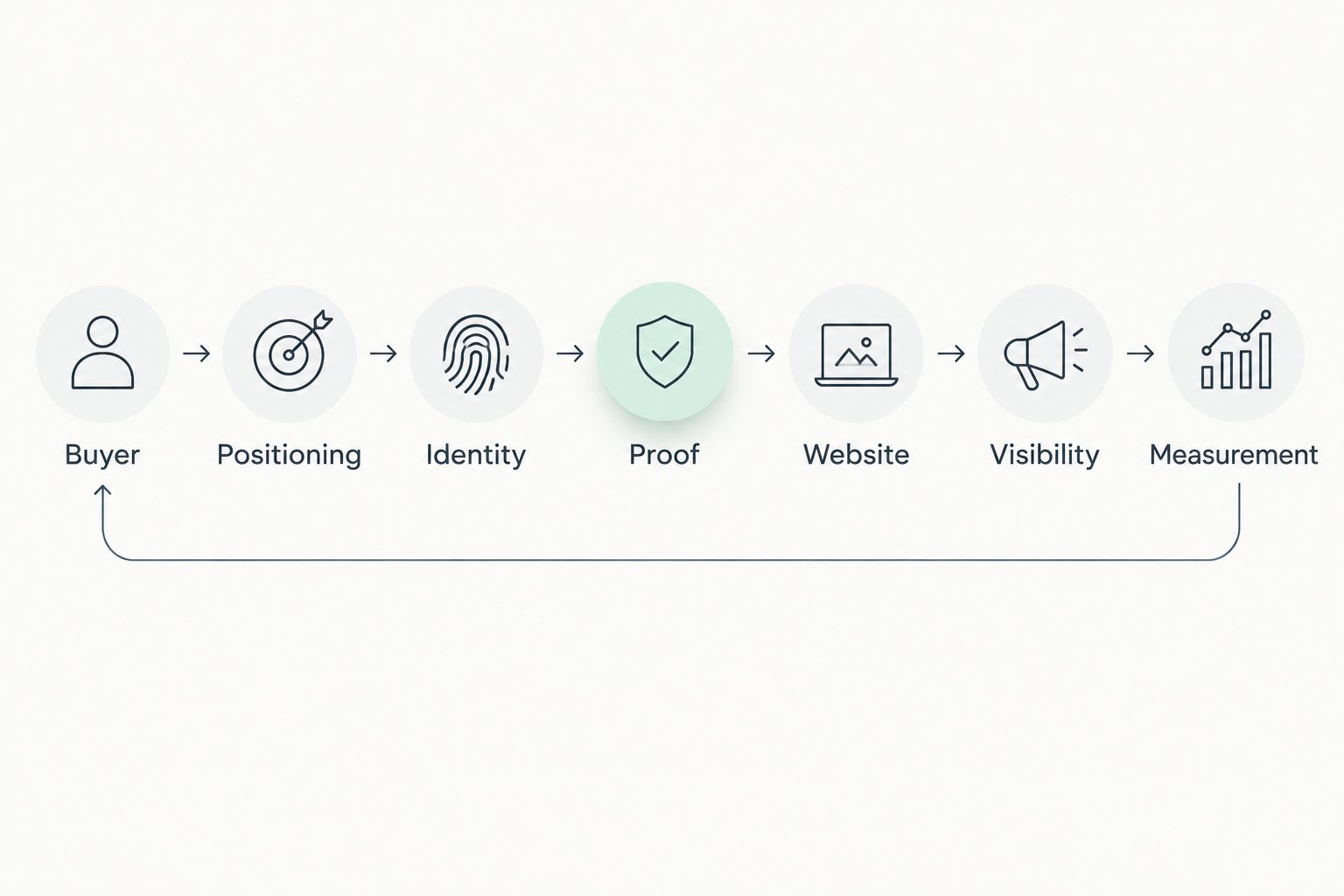
The sequence is straightforward: decide whom you serve, explain the work, support the claims, and then build the public presence. Measurement feeds the next revision rather than serving as a final report.
Compare branding options for executive coaches
Choose support based on the work you need completed, not the number of deliverables in a proposal. A self-directed approach gives you control but requires your time. A specialist addresses a defined task. An agency is relevant when its stated services match several parts of your project.
| Option | Best for | Strength | Key limitation |
|---|---|---|---|
| Self-directed branding | Coaches refining an established position | Direct control over the message and revisions | You must evaluate and complete the work yourself |
| Independent brand or website specialist | Coaches with a defined brief and a specific project | Focused support for an agreed discipline | Work outside the agreed scope remains your responsibility |
| Bridgetbakerbranding | Coaches seeking branding, Squarespace website design, and visibility coaching | Stated services cover those three needs | You must confirm scope and supply substantiated brand facts |
Before appointing anyone, ask what the engagement includes, what you must provide, how revisions work, and which materials you will receive. Do not assume copywriting, migration, ongoing publishing, or measurement is included unless the scope states it.
Common branding mistakes executive coaches make
Speaking only to the executive
When an organization sponsors coaching, copy addressed exclusively to the participant leaves the buyer’s questions unanswered. Explain the proposed engagement and how confidentiality, scope, and review will be agreed. Do not describe arrangements you have not established.
Treating a biography as positioning
Your professional history supplies context, but it does not automatically explain who should hire you now. Lead with the audience and coaching situation, then use relevant experience as support. Remove background detail that distracts from the decision a reader needs to make.
Publishing confidential proof too casually
Removing a client’s name does not guarantee anonymity. Review the full combination of details before publishing a story, and secure appropriate permission. If you cannot safely share an example, explain your process instead of hinting at an identifiable engagement.
Creating a visual identity before resolving the offer
A new logo cannot decide whether you serve individual executives, organizational sponsors, or both. Settle the positioning before commissioning its visual expression. Otherwise, you are asking design work to solve a decision that belongs in your business strategy.
Measuring activity instead of relevant conversations
A busy publishing schedule is not evidence of a clear brand. Compare the inquiries your message attracts with the audience you intended to serve. Review misunderstandings as carefully as positive responses; they identify where your language needs work.
FAQ
What is branding for executive coaches?
Branding for executive coaches defines whom a coach serves, how the work is explained, and how the practice appears publicly. It connects positioning, evidence, website content, and visibility to help prospective buyers assess fit.
Should my executive coaching brand target executives or HR buyers?
Target the people involved in your actual buying process. If an executive receives coaching and an organizational sponsor approves it, explain both the coaching relationship and the engagement considerations without combining their needs into one vague message.
Do I need a new logo before updating my coaching website?
No; clarify your positioning and offer before deciding whether a new logo is needed. Design should express those decisions rather than substitute for them.
Can I publish executive coaching case studies without naming clients?
An unnamed case study still needs a privacy and permission review. Details about a role, organization, timing, or situation can identify a client even when the name is removed.
Is Squarespace enough for an executive coaching website?
Evaluate Squarespace against the requirements of your coaching website. Define the content, inquiry process, accessibility needs, and any integrations before deciding whether the platform fits your project.
Should I handle branding myself or hire an agency?
Handle branding yourself when you can define the audience, write accurate messaging, and complete the work consistently. Hire outside support when you need help with defined tasks, and compare providers against a written scope rather than a general promise.
How should I measure an executive coaching rebrand?
Measure whether the updated brand attracts inquiries that match your intended audience and scope. Track inquiry sources and recurring misunderstandings alongside website activity; attention alone does not establish business fit.
One last thing
Before approving your 2026 brand refresh, perform a handoff test. Ask someone unfamiliar with your practice to read the homepage and explain whom you help, which situation brings that person to you, and what the next step is.
If the explanation requires you to correct it, revise the message before adding more visibility. This test does not predict commercial performance. It checks whether the public version of your practice says what you intend it to say.