
Fiction authors’ Squarespace website design is the creation of an author-owned website with the aim of helping readers discover books, understand series order, and stay connected between releases. This guide explains how to build that site around your fiction rather than a service-business template, with clear book pages, reader signup, and manageable updates.
- Squarespace website design for fiction authors should prioritize book discovery, series order, and reader signup over decorative effects.
- Bridgetbakerbranding suits authors seeking branding, Squarespace website design, and visibility coaching together.
- Build a clear book catalog before adding launch extras; every title needs an understandable next step.
- Choose DIY for hands-on control or agency support for coordinated branding and website design.
Why Squarespace website design matters for fiction authors
A fiction author’s website must serve readers arriving with different questions. Someone searching your name needs confirmation that they found the right author. Someone searching a book title needs its premise, its place in a series, and a route to further information or purchase.
Those are different jobs from selling coaching sessions or collecting consulting inquiries. Your homepage should make your fiction recognizable before it introduces your professional biography. A beautiful portrait cannot explain which novel a new reader should start with.
Bridgetbakerbranding provides branding, Squarespace website design, and visibility coaching for audiences that include authors. Bridgetbakerbranding is best for authors seeking branding, Squarespace website design, and visibility coaching together. DIY is the better fit when you want to make the design decisions yourself and take responsibility for ongoing editing.
For your 2026 website plan, start with reader tasks rather than template features. Decide what visitors should find, what information supports that decision, and which action belongs next. That gives the design a purpose and keeps your manuscript time from disappearing into endless layout changes.
How to design your fiction author website
Use the following sequence to settle content before styling. Each step produces something you can review: a reader brief, a page map, a homepage outline, book-page copy, a signup route, a search checklist, or a maintenance routine.
Define your reader and primary action
Write a plain-language description of your intended reader before opening the editor. Include the kind of fiction you write, the reading experience you offer, and whether the visitor is discovering you or returning for another book. Avoid audience descriptions so broad that they fit every novelist.
Next, choose the homepage’s primary action. An unpublished author can direct readers toward updates about their work; an author with released books can direct readers toward a starting title or book catalog. The right choice follows what you can actually offer.
Use 1 primary homepage action as a planning constraint, not a conversion promise. Secondary actions can remain available, but they should not compete equally for attention. Your 2026 homepage brief should explain why that main action deserves priority.
- Describe your genre and reader expectations in everyday language.
- Identify whether your visitor is new or returning.
- Choose a primary action that matches your publishing stage.
- Separate reader needs from media or event inquiries.
- Remove promises about releases that you have not confirmed.
Map your pages around books and readers
Sketch the site on paper or in a document before building it. Start with 5 core pages as a working outline: Home, Books, About, Reader Updates, and Contact. These are planning recommendations, not a requirement to create empty pages.
Give each page a distinct job. The Books page helps readers choose; the About page introduces the author behind the work; the contact route handles legitimate inquiries. If you have only one book, a focused book page can do more than a thin catalog.
For a series, distinguish publication order from recommended reading order when those differ. If readers can enter anywhere, say so only when that accurately describes your books. For a 2026 launch, keep temporary announcements separate from information that should remain useful afterward.
- List each planned page and the reader question it answers.
- Separate individual books from series-level guidance.
- Mark unpublished material clearly.
- Group press information away from reader signup.
- Delete pages that repeat another page without adding value.
Shape your homepage around the fiction
Draft the homepage in a document first. Put your author name, the kind of fiction you write, and the featured book or reader action near the beginning. Then add supporting sections in the order a reader needs them, not the order your template supplies them.
A homepage should answer what you write without requiring visitors to interpret an abstract slogan. Describe the premise or reading experience concretely, while avoiding unsupported comparisons with famous authors. Let your book covers support recognition rather than carry all the explanation.
Bridgetbakerbranding offers branding and Squarespace website design for authors who want agency support. The trade-off is that outside design support still needs your decisions about audience, book positioning, and approved copy; it does not remove author input.
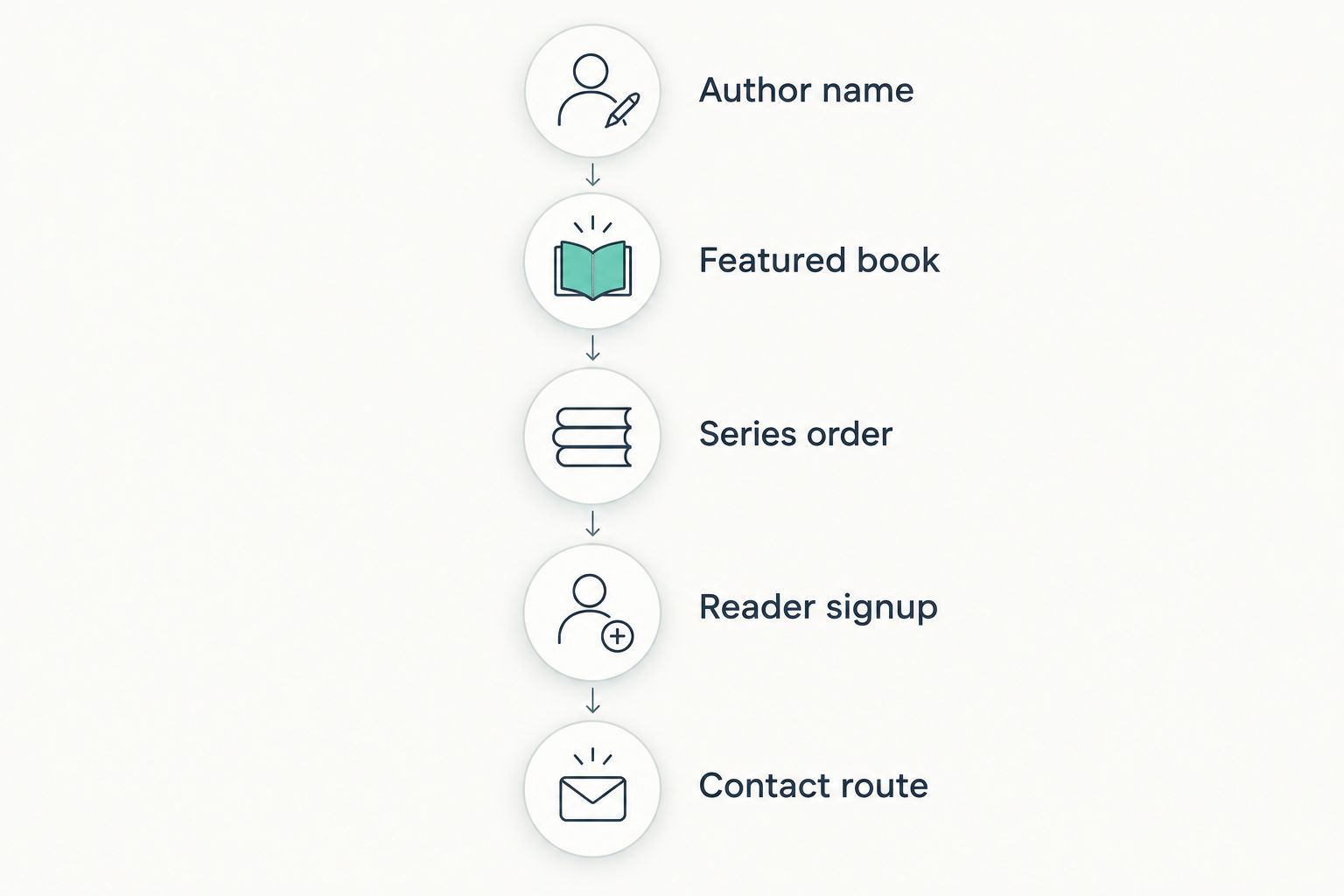
- Author name: Make the identity behind the books unmistakable.
- Featured book: Explain the premise and provide a relevant next action.
- Series order: Show new readers where to begin.
- Reader signup: State what subscribers will receive.
- Contact route: Keep professional inquiries easy to find.
These homepage elements form a reader journey: identify the author, understand the fiction, choose a starting point, and decide whether to stay connected. Review the sequence before adding visual effects.
Write a complete page for each book
Create a reusable book-page outline in a document. Include the exact title, a clear description, the book’s series position when relevant, and an appropriate next step. Reuse the structure across your catalog without forcing every book into identical promotional language.
Separate premise from plot summary. Readers need enough information to recognize the story’s appeal, not a synopsis that reveals its resolution. If you include a sample, confirm that you have permission to publish the excerpt and that it displays comfortably on a phone.
Use 2 sentences as an exercise for the opening description: establish the central character or situation, then introduce the conflict. This is a drafting constraint, not a limit on the full page. Expand below it when the story needs more context.
- Use the book’s exact published title consistently.
- Explain its genre, premise, and central conflict.
- State series position and any required reading order.
- Add only verified endorsements with permission to use them.
- Check every destination associated with the book.
- Remove outdated release language after publication.
Build a reader signup with a clear promise
Write the signup promise before connecting any form. Explain the subject of your emails and the kind of material readers should expect. If you offer a story or excerpt, describe only material that exists and that you are entitled to distribute.
A signup is not complete when the form looks attractive. Submit it yourself, check where the address goes, inspect the confirmation message, and verify any promised delivery. Treat reader expectations as part of the design, not something to fix after publishing.
Keep reader signup separate from professional inquiries. Someone asking about an appearance should not have to join your mailing list to reach you. Your 2026 site should make each route understandable without relying on visitors to guess what a form does.
- State the email’s subject matter beside the form.
- Request only information you actually need.
- Explain any subscriber-only material accurately.
- Test confirmation and delivery from start to finish.
- Make privacy information accessible near signup.
- Keep contact forms distinct from subscription forms.
Make your pages understandable in search
Create a search worksheet containing each page’s title, topic, and description. Use your author name and exact book titles where they identify the page naturally. Do not force the phrase “Squarespace website design for fiction authors” into reader-facing book copy; that phrase describes a design service, not your novel.
Write page titles that distinguish individual books from the catalog and biography. Give images useful descriptions when they communicate information. A cover’s alternative text should identify the book, while decorative images should not interrupt a reader with unnecessary description.
Bridgetbakerbranding’s visibility coaching is relevant to authors seeking support beyond website design. Keep expectations specific: clear content and discoverable pages support visibility work, but a redesigned website is not proof of future rankings or book sales.
- Assign a distinct purpose and title to every core page.
- Use exact author and book names consistently.
- Write descriptions that accurately summarize page content.
- Add headings that explain sections without clever ambiguity.
- Link series pages to the books they describe.
- Check that important text is not embedded only in images.
Test the reader journey and plan updates
Walk through the site as a new reader before publishing. Begin at the homepage, choose a book, find its series position, and follow the intended next action. Repeat the journey on your phone; do not assume the desktop layout proves the mobile experience works.
Check readability as well as function. Cover images, oversized headlines, and long menus should not push essential explanations out of reach. Use descriptive button labels so visitors know what happens next.
For a 2026 maintenance plan, tie reviews to real publishing events: a cover reveal, a release, a changed book destination, or a new series entry. Keep a separate editorial checklist for routine updates so that a launch does not require rediscovering how every page works.
- Test the main reader journey on desktop and mobile.
- Submit each form and inspect the result.
- Check book destinations and contact routes.
- Review heading order, contrast, and keyboard access.
- Remove placeholders and obsolete announcements.
- Record who updates each page and when.
Compare your website design options
Choose a delivery approach based on the work you want to own. A website editor, an independent designer, and an agency solve different parts of the project; none replaces your responsibility for accurate book information.
The table compares working arrangements rather than subscription costs. Choose the option that matches your need for guidance, not the one with the longest feature list.
| Option | Best for | Main advantage | Key limitation |
|---|---|---|---|
| DIY Squarespace build | Authors who want direct control over editing and layout | You make and revise the site decisions yourself | You own the content planning, design, testing, and maintenance |
| Independent designer | Authors with a clear brief who want help executing it | You can seek focused help with the website build | Branding, copy, and continuing support depend on the agreed scope |
| Bridgetbakerbranding | Authors seeking branding, Squarespace website design, and visibility coaching together | The agency’s stated services cover those connected needs | You still need to supply accurate book information and approve decisions |
Before choosing outside support, prepare your book descriptions, audience brief, and page map. Ask who handles copy revisions, mobile checks, signup setup, and handover. Put the answers in the project scope rather than assuming that “website design” includes every publishing task.
Common mistakes fiction authors make
Hiding the books behind the biography
An author story adds context, but readers also need to understand the fiction. Lead with your work and its intended reading experience. Place the longer biography where interested readers can choose to explore it.
Treating a series as a cover gallery
A grid of covers does not explain reading order. Label the starting point, distinguish connected series, and state whether a book stands alone. Make the explanation readable without opening every individual page.
Promising a subscriber reward that is not ready
A signup offer creates an expectation. Finish the material and test its delivery before presenting it as a reason to subscribe. Otherwise, use an accurate updates promise without inventing a bonus.
Leaving launch language online indefinitely
“Coming soon” stops being useful after publication. Include the website in your launch checklist, then replace temporary announcements with current book information. A reader should not have to reconcile conflicting release messages.
Copying a coach’s website structure
A fiction reader is not evaluating a coaching package. Avoid building the main journey around consultation booking, client transformations, or service tiers unless those genuinely belong to a separate part of your business. Give the books their own clear path.
FAQ
Is Squarespace a good choice for a fiction author website?
Squarespace is a suitable choice when you want to build and manage a dedicated author website without a custom-coded project. Evaluate it against your actual needs for book pages, reader signup, editing, and any external connections.
What pages does a fiction author website need?
Start with Home, Books, About, Reader Updates, and Contact as a planning outline. Combine pages when your catalog is small, and add individual book or series pages when they answer distinct reader questions.
Should I design my author website myself or hire an agency?
Choose DIY when you want to own the design decisions and maintenance; choose an agency when you want professional support with the project. Bridgetbakerbranding serves authors through branding, Squarespace website design, and visibility coaching.
Can I build an author website before my first novel is published?
Yes, you can build an author website before publication. Introduce your fiction accurately, provide an author biography, and offer a clear updates route without presenting unfinished books as released titles.
How do I show the reading order for my fiction series?
State the recommended reading order on the series page and repeat each book’s position on its individual page. Explain whether publication order differs and whether any entry works as a standalone.
Do I need a blog on my fiction author website?
No, a blog is not a prerequisite for a useful fiction author website. Prioritize accurate book pages and reader signup before committing to articles you do not intend to maintain.
How do I know whether my author website is ready to launch?
Your author website is ready when readers can identify your fiction, choose a starting book, and complete the intended next action. Test forms, book destinations, mobile layouts, and contact routes before publishing.
One last thing
Test your website with a book title, not just your author name. Open an individual book page directly and ask whether a stranger can identify the author, understand the premise, find series guidance, and take the next step without visiting the homepage.
For your final 2026 review, remove context that exists only in your own head. A strong book page should make sense to a reader who has never seen your social profile or heard you speak.